
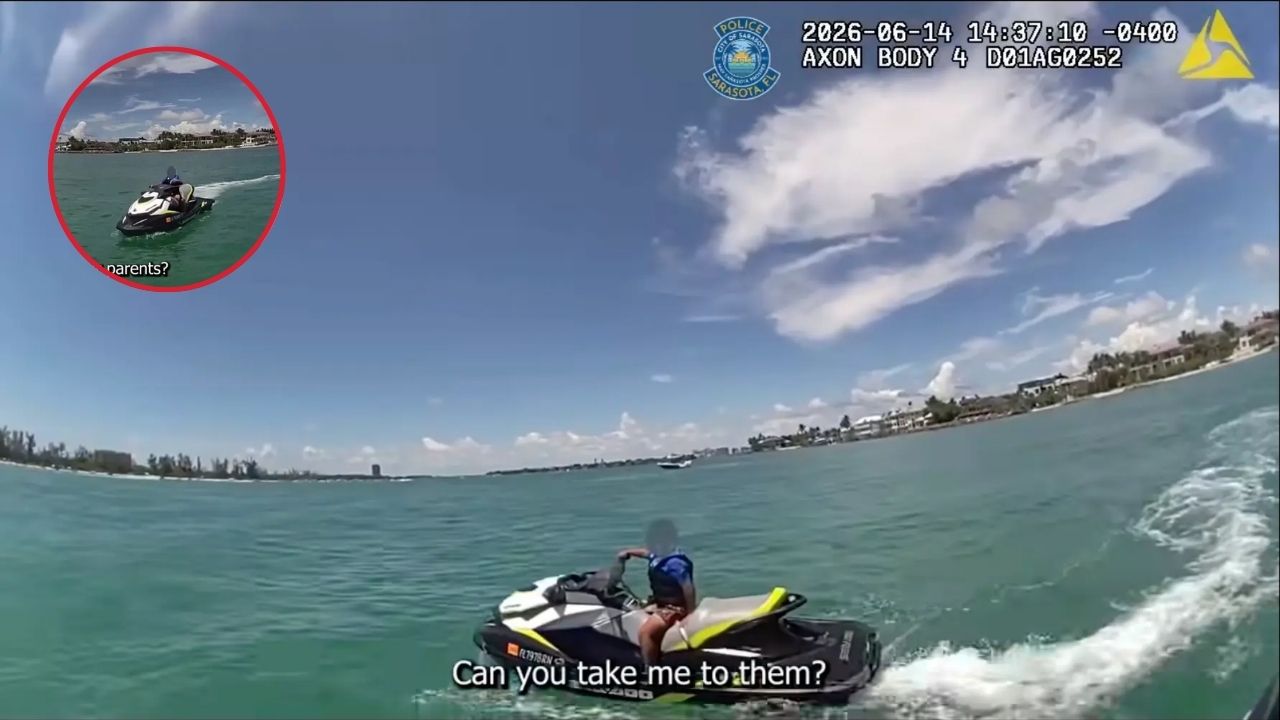
A routine patrol along Florida’s Gulf Coast turned into a law enforcement investigation after officers found an 8-year-old boy operating a Jet Ski without an adult nearby.
The incident occurred on June 14 near Lido Key in Sarasota, where officers from the Sarasota Police Department’s Marine Patrol Unit were monitoring boating activity. Video later shared by the department captured the encounter, showing officers approaching the young rider and asking a simple but important question: “Where’s your parents?”
According to police, the child was riding alone despite busy waterways and rough water conditions, prompting officers to intervene immediately.
Officers Follow Boy to His Father
After being asked about his parents, the child pointed officers toward his father, who was nearby on the water.
Marine patrol officers followed the boy until they reached the adult, who acknowledged that the child was his son.
During the conversation, officers asked the father whether he realized the youngster was operating the personal watercraft by himself.
The father admitted that he believed his son was likely too young to legally ride the Jet Ski but explained that the child had experience using similar watercraft on lakes over the past few years.
He told officers that although his son was only 8 years old, he considered him capable because of that previous experience.
Florida Law Sets Clear Age Requirement
Despite the father’s explanation, Florida law establishes strict rules regarding who can legally operate a personal watercraft such as a Jet Ski.
State regulations require operators to be at least 14 years old before they can independently drive a personal watercraft.
The age requirement applies regardless of the child’s previous riding experience or comfort level on the water.
Law enforcement officials say these rules exist because operating a high-powered watercraft requires quick decision-making, awareness of surrounding vessels and the ability to respond safely to changing water conditions.
Since the child involved in this incident was only 8 years old, officers determined that the operation violated state law.
Father Faces Misdemeanor Charge
Following the investigation, Sarasota police charged the father with a second-degree misdemeanor connected to allowing the child to operate the Jet Ski.
Authorities have not publicly released the father’s identity or additional personal information.
He is expected to appear in court at a later date, where the charge will be addressed through the legal process.
Police have not announced whether any additional citations or penalties were issued in connection with the incident.
Busy Waterways Raised Safety Concerns
According to officers, one of the factors that increased concern was the environment in which the child was operating the Jet Ski.
Marine patrol officers observed numerous boats and other personal watercraft using the area at the same time.
They also noted that water conditions included rough currents, making navigation more challenging even for experienced riders.
Busy recreational waterways require operators to monitor surrounding traffic, maintain safe distances and react quickly to changing conditions.
Authorities said those responsibilities become even more significant when children are involved.
Experience Does Not Replace Legal Requirements
During the interaction with officers, the father explained that his son had ridden Jet Skis on lakes for several years and was comfortable operating them.
However, law enforcement emphasized that personal experience does not replace Florida’s legal age requirements.
Safety regulations are designed to create consistent standards for everyone using public waterways, regardless of individual skill levels.
Officials say even confident young riders may lack the maturity needed to recognize hazards, judge distances or respond appropriately during emergencies.
The law therefore establishes minimum operating ages rather than relying on personal assessments of ability.
Importance of Personal Watercraft Safety
Jet Skis are among the most popular recreational watercraft in Florida, especially during the summer months.
Although they are designed for fun, they are capable of traveling at high speeds and require responsible operation.
Safety experts recommend that operators:
- Understand local boating laws before riding.
- Wear properly fitted life jackets at all times.
- Stay aware of nearby boats and swimmers.
- Avoid operating during hazardous water conditions.
- Complete approved boating safety education when required.
Parents and guardians are also encouraged to supervise young riders closely and ensure children participate only in activities permitted under state regulations.
Marine Patrol Continues Enforcement
The Sarasota Police Department regularly patrols local waterways to promote boating safety and enforce state laws.
Marine officers conduct routine checks involving vessel registration, life jacket compliance, boating under the influence and age requirements for watercraft operators.
During periods of increased recreational boating activity, patrols often become more visible to reduce preventable incidents and encourage safe behavior among visitors and residents alike.
Officials say education remains an important part of these patrols, but enforcement is necessary when serious violations occur.
Reminder for Families Enjoying Florida Waters
Florida attracts millions of visitors each year who enjoy boating, fishing and personal watercraft activities along its coastline.
As waterways become busier during holidays and summer weekends, authorities remind families to review state boating regulations before heading onto the water.
Understanding age limits, required safety equipment and operating rules can help prevent legal issues while reducing the risk of accidents.
In this case, officers acted after noticing a young child riding alone in challenging conditions. Their response led to criminal charges against the father, underscoring that state safety laws apply regardless of prior riding experience or parental confidence in a child’s abilities.
The incident also serves as a broader reminder that recreational activities involving powerful watercraft require careful supervision and strict adherence to established regulations. By following Florida’s boating laws, families can better protect themselves and others while enjoying the state’s waterways responsibly.